


MAXIMIZE BRONCHODILATION...1,2*
Primary endpoint: 150 mL increase from baseline in predose FEV1 at Week 24 vs placebo (P<0.0001) in Trial 11,2†
BEVESPI AEROSPHERE is NOT a rescue medication and does NOT replace fast-acting inhalers to treat acute symptoms.
Primary endpoint: 150 mL increase from baseline in predose FEV1 at Week 24 vs placebo (P<0.0001) in Trial 11,2†
BEVESPI AEROSPHERE is NOT a rescue medication and does NOT replace fast-acting inhalers to treat acute symptoms.
*Improvements in lung function, including predose FEV1† and peak FEV1 ,‡ relative to its individual components and placebo in two 24-week pivotal trials
Primary endpoint: Change from baseline in morning predose FEV1 at Week 241,2


All study treatments administered BID.
- There was also an increase from baseline in predose FEV1 at Week 24 for BEVESPI AEROSPHERE vs glycopyrrolate 18 mcg (59 mL) and formoterol fumarate 9.6 mcg (64 mL) (both P<0.0001).1,2 Statistically significant improvement in morning predose FEV1 was also demonstrated in Trial 21,2
- Adverse reactions with BEVESPI AEROSPHERE with a ≥2% incidence and more common than placebo were urinary tract infection and cough1†
*Improvements in lung function relative to its individual components and placebo in two 24-week pivotal trials.
FEV1 - forced expiratory volume in one second
RESCUE MEDICATION USE
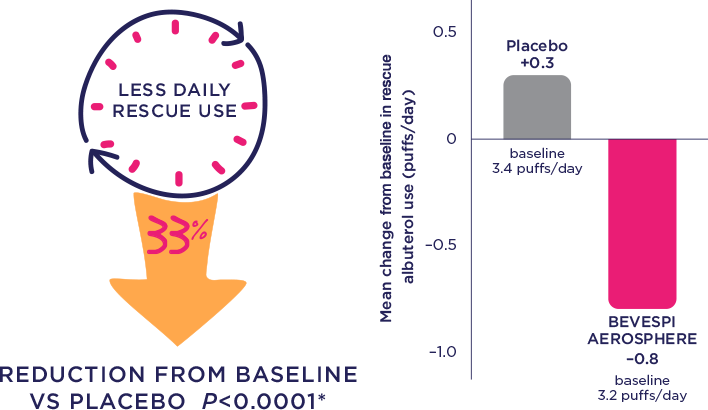
Secondary endpoint: Daily rescue albuterol use reduced by nearly one-third compared with placebo over 24 weeks1-4
All treatments were administered BID.
Top- BEVESPI AEROSPHERE (glycopyrrolate/formoterol fumarate) is NOT a rescue medication and does NOT replace fast-acting inhalers to treat acute symptoms
- In Trial 1, mean change from baseline in daily rescue albuterol use was -0.8 puffs/day (baseline 3.2 puffs/day) over 24 weeks with BEVESPI AEROSPHERE (n=525), compared with an increase of 0.3 puffs/day with placebo (n=218) (P<0.0001)1-3†
- Statistically significant reduction in average daily rescue medication use vs placebo was also demonstrated in Trial 21,2,4‡
- Adverse reactions with BEVESPI AEROSPHERE with a ≥2% incidence and more common than placebo were urinary tract infection and cough1
*P value is based on treatment comparison of absolute mean change from baseline for BEVESPI AEROSPHERE vs placebo.
†In Trial 1, mean change from baseline in daily rescue albuterol use over 24 weeks was -0.5 puffs/day (baseline 3.4 puffs/day) with glycopyrrolate 18 mcg (n=449), -0.8 puffs/day (baseline 3.4 puffs/day) with formoterol fumarate 9.6 mcg (n=446), and 0.3 puffs/day (baseline 3.4 puffs/day) with placebo (n=218) (P<0.0001 for all active treatments vs placebo).
‡Trial 2 demonstrated a 31% reduction from baseline in rescue albuterol use vs placebo (P<0.0001). P value is based on treatment comparison of absolute mean change from baseline for BEVESPI AEROSPHERE vs placebo. In Trial 2, mean change from baseline in daily rescue albuterol use was -1.0 puffs/day over 24 weeks with BEVESPI AEROSPHERE (baseline 3.2 puffs/day, n=510), -0.4 puffs/day with glycopyrrolate 18 mcg (baseline 3.6 puffs/day, n=438), -0.7 puffs/day with formoterol fumarate 9.6 mcg (baseline 3.5 puffs/day, n=437), and 0.0 puffs/day with placebo (baseline 3.9 puffs/day, n=223) (P<0.01 for all active treatments vs placebo).
Please see Important Safety Information and full Prescribing Information, including Boxed WARNING available on website.
References: 1. BEVESPI AEROSPHERE® (glycopyrrolate and formoterol fumarate) Inhalation Aerosol [prescribing information]. Wilmington, DE: AstraZeneca Pharmaceuticals LP; 2023. 2. Martinez FJ, Rabe KF, Ferguson GT, et al. Chest. 2017;151(2):340-357. 3. Data on File, REF-5037, AZPLP. 4. Data on File, REF-5036, AZPLP.
STUDY DESIGN
The clinical development program for BEVESPI AEROSPHERE (glycopyrrolate/formoterol fumarate) included two 24-week, randomized, double-blind, placebo-controlled, parallel-group trials in subjects with moderate to very severe COPD. Both trials evaluated BEVESPI AEROSPHERE 18 mcg/9.6 mcg, glycopyrrolate 18 mcg, formoterol fumarate 9.6 mcg, and placebo administered twice daily. Trial 1 also included an open-label active control.1
The primary endpoint for Trial 1 and Trial 2 was change from baseline in trough FEV1 at Week 24 compared with placebo, glycopyrrolate 18 mcg twice daily, and formoterol fumarate 9.6 mcg twice daily. The comparison of BEVESPI AEROSPHERE with glycopyrrolate 18 mcg and formoterol fumarate 9.6 mcg was assessed to evaluate the contribution of the individual components to BEVESPI AEROSPHERE.1 Secondary endpoints included change from baseline in peak FEV1 at Week 24 and change from baseline in daily rescue albuterol use over 24 weeks.1,2
Inclusion criteria: A clinical diagnosis of COPD, between 40 to 80 years of age, a history of smoking ≥10 pack-years, a post-albuterol FEV1 of <80% of predicted normal values, and a ratio of FEV1/FVC <0.7.1,2
PATIENT POPULATION
Of the 3699 subjects included in the 24-week trials for BEVESPI AEROSPHERE, the majority were male (56%) and Caucasian (91%), with a mean age of 63 years and an average smoking history of 51 pack-years (54% current smokers). During screening, mean postbronchodilator percent predicted FEV1 was 51% (range: 19% to 82%) and mean percent reversibility was 20% (range: -32% to 135%).1
Please see Important Safety Information and full Prescribing Information, including Boxed WARNING available on website.
References: 1. BEVESPI AEROSPHERE® (glycopyrrolate and formoterol fumarate) Inhalation Aerosol [prescribing information]. Wilmington, DE: AstraZeneca Pharmaceuticals LP; 2023. 2. Martinez FJ, Rabe KF, Ferguson GT, et al. Chest. 2017;151(2):340-357.
FOOTNOTE
†In Trial 2, change in morning predose FEV1 at Week 24 with BEVESPI AEROSPHERE (glycopyrrolate/formoterol fumarate) (n=433) was 103 mL vs placebo (n=170, P<0.0001), 54 mL vs glycopyrrolate 18 mcg (n=367, P<0.001), and 56 mL vs formoterol fumarate 9.6 mcg (n=350, P<0.001).
Secondary endpoint: Mean change from baseline in peak FEV1 within 2 hours post-dose at Week 241,2


All study treatments administered BID.
- Secondary endpoint: In Trial 1, there were significant improvements from baseline at Week 24 in peak FEV1 for BEVESPI AEROSPHERE vs glycopyrrolate 18 mcg BID, formoterol fumarate 9.6 mcg BID, and placebo (P<0.0001 for all).1,2 Statistically significant improvement in peak FEV1 was also demonstrated in Trial 21,2‡
- Adverse reactions with BEVESPI AEROSPHERE with a ≥2% incidence and more common than placebo were urinary tract infection and cough1
*Improvements in lung function relative to its individual components and placebo in two 24-week pivotal trials.
FEV1 - forced expiratory volume in one second
STUDY DESIGN
The clinical development program for BEVESPI AEROSPHERE (glycopyrrolate/formoterol fumarate) included two 24-week, randomized, double-blind, placebo-controlled, parallel-group trials in subjects with moderate to very severe COPD. Both trials evaluated BEVESPI AEROSPHERE 18 mcg/9.6 mcg, glycopyrrolate 18 mcg, formoterol fumarate 9.6 mcg, and placebo administered twice daily. Trial 1 also included an open-label active control.1
The primary endpoint for Trial 1 and Trial 2 was change from baseline in trough FEV1 at Week 24 compared with placebo, glycopyrrolate 18 mcg twice daily, and formoterol fumarate 9.6 mcg twice daily. The comparison of BEVESPI AEROSPHERE with glycopyrrolate 18 mcg and formoterol fumarate 9.6 mcg was assessed to evaluate the contribution of the individual components to BEVESPI AEROSPHERE.1 Secondary endpoints included change from baseline in peak FEV1 at Week 24 and change from baseline in daily rescue albuterol use over 24 weeks.1,2
Inclusion criteria: A clinical diagnosis of COPD, between 40 to 80 years of age, a history of smoking ≥10 pack-years, a post-albuterol FEV1 of <80% of predicted normal values, and a ratio of FEV1/FVC <0.7.1,2
PATIENT POPULATION
Of the 3699 subjects included in the 24-week trials for BEVESPI AEROSPHERE, the majority were male (56%) and Caucasian (91%), with a mean age of 63 years and an average smoking history of 51 pack-years (54% current smokers). During screening, mean postbronchodilator percent predicted FEV1 was 51% (range: 19% to 82%) and mean percent reversibility was 20% (range: -32% to 135%).1
Please see Important Safety Information and full Prescribing Information, including Boxed WARNING available on website.
References: 1. BEVESPI AEROSPHERE® (glycopyrrolate and formoterol fumarate) Inhalation Aerosol [prescribing information]. Wilmington, DE: AstraZeneca Pharmaceuticals LP; 2023. 2. Martinez FJ, Rabe KF, Ferguson GT, et al. Chest. 2017;151(2):340-357.
RESCUE MEDICATION USE
Secondary endpoint: Daily rescue albuterol use reduced by nearly one-third compared with placebo over 24 weeks1-4
All treatments were administered BID.
Top- BEVESPI AEROSPHERE (glycopyrrolate/formoterol fumarate) is NOT a rescue medication and does NOT replace fast-acting inhalers to treat acute symptoms
- In Trial 1, mean change from baseline in daily rescue albuterol use was -0.8 puffs/day (baseline 3.2 puffs/day) over 24 weeks with BEVESPI AEROSPHERE (n=525), compared with an increase of 0.3 puffs/day with placebo (n=218) (P<0.0001)1-3†
- Statistically significant reduction in average daily rescue medication use vs placebo was also demonstrated in Trial 21,2,4‡
- Adverse reactions with BEVESPI AEROSPHERE with a ≥2% incidence and more common than placebo were urinary tract infection and cough1
*P value is based on treatment comparison of absolute mean change from baseline for BEVESPI AEROSPHERE vs placebo.
†In Trial 1, mean change from baseline in daily rescue albuterol use over 24 weeks was -0.5 puffs/day (baseline 3.4 puffs/day) with glycopyrrolate 18 mcg (n=449), -0.8 puffs/day (baseline 3.4 puffs/day) with formoterol fumarate 9.6 mcg (n=446), and 0.3 puffs/day (baseline 3.4 puffs/day) with placebo (n=218) (P<0.0001 for all active treatments vs placebo).
‡Trial 2 demonstrated a 31% reduction from baseline in rescue albuterol use vs placebo (P<0.0001). P value is based on treatment comparison of absolute mean change from baseline for BEVESPI AEROSPHERE vs placebo. In Trial 2, mean change from baseline in daily rescue albuterol use was -1.0 puffs/day over 24 weeks with BEVESPI AEROSPHERE (baseline 3.2 puffs/day, n=510), -0.4 puffs/day with glycopyrrolate 18 mcg (baseline 3.6 puffs/day, n=438), -0.7 puffs/day with formoterol fumarate 9.6 mcg (baseline 3.5 puffs/day, n=437), and 0.0 puffs/day with placebo (baseline 3.9 puffs/day, n=223) (P<0.01 for all active treatments vs placebo).
Please see Important Safety Information and full Prescribing Information, including Boxed WARNING available on website.
References: 1. BEVESPI AEROSPHERE® (glycopyrrolate and formoterol fumarate) Inhalation Aerosol [prescribing information]. Wilmington, DE: AstraZeneca Pharmaceuticals LP; 2023. 2. Martinez FJ, Rabe KF, Ferguson GT, et al. Chest. 2017;151(2):340-357. 3. Data on File, REF-5037, AZPLP. 4. Data on File, REF-5036, AZPLP.
FOOTNOTE
†There was also an increase from baseline in predose FEV1 at Week 24 for BEVESPI AEROSPHERE (glycopyrrolate/formoterol fumarate) vs glycopyrrolate 18 mcg (59 mL) and formoterol fumarate 9.6 mcg (64 mL) (both P<0.0001). Statistically significant improvement in morning predose FEV1 was also demonstrated in Trial 2. In Trial 2, change in morning predose FEV1 at Week 24 with BEVESPI AEROSPHERE (n=433) was 103 mL vs placebo (n=170, P<0.0001), 54 mL vs glycopyrrolate 18 mcg (n=367, P<0.001), and 56 mL vs formoterol fumarate 9.6 mcg (n=350, P<0.001).
‡In Trial 2, the mean peak FEV1 improvement from baseline at Week 24 with BEVESPI AEROSPHERE (n=431) was 267 mL vs placebo (n=165), 126 mL vs glycopyrrolate 18 mcg (n=365), and 81 mL vs formoterol fumarate 9.6 mcg (n=346) (P<0.0001 for all).
In separate Phase IIIb Trials: Through the breathing cycle3,4

BEVESPI AEROSPHERE is NOT a rescue medication and does NOT replace fast-acting inhalers to treat acute symptoms.
FROM EXPIRATION…
Achieved ~300 mL improvement in peak FEV1 vs placebo3
Two separate Phase IIIb clinical trials evaluated the efficacy and safety of BEVESPI compared with placebo (Study A, n=35; Study B, n=75)3
- Primary endpoint: Mean improvements in FEV1 AUC0-24 on Day 29 for BEVESPI vs placebo were 249 mL and 265 mL (for Study A and Study B, respectively; both P<0.0001)4§
- Secondary endpoint: Mean changes from baseline in peak FEV1 on Day 29 (evening) for BEVESPI vs placebo were 293 mL and 337 mL (for Study A and Study B, respectively; P<0.0001)3
…THROUGH INSPIRATION
Achieved a 381 mL improvement in peak inspiratory capacity vs placebo3
- Secondary endpoint (continued): Mean improvements in peak IC from baseline on Day 29 (evening) for BEVESPI vs placebo were 381 mL (19.4%) and 312 mL (16.5%) (for Study A and Study B, respectively; both P<0.0001)4,5||¶
- Adverse events were numerically similar across treatment arms3
All study treatments were administered BID.
INSPIRATORY CAPACITY
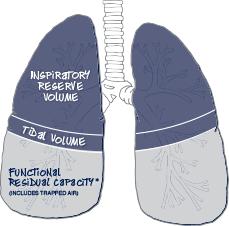
- Inspiratory capacity is the maximum amount of air that can be taken in after a normal breath1
- In COPD, residual air trapped in the lungs after expiration reduces patients’ inspiratory capacity1,2
*Functional Residual Capacity (which includes trapped air) = Expiratory Reserve Volume + Residual Volume.1
References: 1. Seeley R. Respiratory System. In: Seeley R, Stephens T, Tate P, eds. Anatomy & Physiology. 6th ed. New York, NY: McGraw-Hill; 2003:813-859. 2. O’Donnell DE, Webb KA, Neder JA. COPD Res Pract. 2015;1:4.
STUDY DESIGN
Two randomized, Phase IIIb, double-blind, multicenter, crossover studies were conducted to evaluate the 24-hour lung function profile of BEVESPI AEROSPHERE (glycopyrrolate/formoterol fumarate) 18 mcg/9.6 mcg twice daily compared with placebo twice daily in patients with moderate to very severe COPD after 4 weeks of chronic dosing (Study A and Study B). Study B also included an open-label active control.1
The primary endpoint was the change in FEV1 AUC0-24 on Day 29 from baseline for BEVESPI AEROSPHERE twice daily compared with placebo twice daily. Secondary endpoints included peak change from baseline in FEV1 and inspiratory capacity following the evening dose on Day 29.1
Inclusion criteria: a clinical diagnosis of COPD, 40 to 80 years of age, a history of smoking ≥10 pack-years, a post-albuterol FEV1 <80% of predicted normal values, and a ratio of FEV1/FVC of <0.70.2
PATIENT POPULATION
In Study A, of the 35 subjects included in the efficacy analysis for BEVESPI AEROSPHERE, the majority were male (57%) and Caucasian (77%), with a mean age of 61 years and an average smoking history of 49 pack-years (57% current smokers). During screening, mean postbronchodilator percent predicted FEV1 was 53% (range: 19% to 79%).2
In Study B, of the 75 subjects included in the efficacy analysis, the majority were female (64%) and Caucasian (91%), with a mean age of 62 years and an average smoking history of 56 pack-years (63% current smokers). During screening, mean postbronchodilator percent predicted FEV1 was 57% (range: 31% to 80%).2
Please see Important Safety Information and full Prescribing Information, including Boxed WARNING available on website.
References: 1. Reisner C, Gottschlich G, Fakih F, et al. Respir Res. 2017;18:157. 2. Data on File, REF-4976, AZPLP.
FOOTNOTE
† Pivotal Trials Primary Endpoint: In Trial 1, the change from baseline in predose FEV1 at Week 24 with BEVESPI AEROSPHERE (glycopyrrolate/formoterol fumarate) (n=429) was 150 mL vs placebo (n=161), 59 mL vs glycopyrrolate 18 mcg (n=344), and 64 mL vs formoterol fumarate 9.6 mcg (n=367); P<0.0001 for all treatment comparisons. Statistically significant results were also seen in Trial 2.
‡ Pivotal Trials Secondary Endpoint: In Trial 1, the change from baseline in peak FEV1 at Week 24 for BEVESPI (n=428) was 291 mL vs placebo (n=160), 133 mL vs glycopyrrolate 18 mcg (n=343), and 93 mL vs formoterol fumarate 9.6 mcg (n=367); P<0.0001 for all treatment comparisons. Statistically significant results were also seen in Trial 2.
Adverse reactions with BEVESPI AEROSPHERE with a ≥2% incidence and more common than placebo were urinary tract infection and cough.
§ Primary endpoint, FEV1 AUC0-24: Study A – BEVESPI AEROSPHERE n=35; Placebo n=31 (Baseline FEV1 1.382 L and 1.345 L, respectively) and Study B – BEVESPI AEROSPHERE n=65; Placebo n=65 (Baseline FEV1 1.328 L and 1.333 L, respectively).
|| Secondary endpoint, peak inspiratory capacity (evening): Study A – BEVESPI AEROSPHERE n=34; Placebo n=30 (Baseline evening inspiratory capacity 1.980 L and 1.939 L, respectively) and Study B – BEVESPI AEROSPHERE n=62; Placebo n=63 (Baseline evening inspiratory capacity 1.877 L and 1.913 L, respectively).
¶ P-value is based on treatment comparison of absolute mean change from baseline for BEVESPI AEROSPHERE vs placebo.
Please see Important Safety Information and full Prescribing Information, including Boxed WARNING available on website.
Top



-
Home
-
Efficasy
-
adverse reactions
-
dual bronchodilation
-
dosing & administration
-
copd patient profile
-
How to use video
-
SAVINGS & SUPPORT


IMPORTANT SAFETY INFORMATION
CONTRAINDICATIONS
All long-acting beta2-adrenergic agonists (LABAs), including formoterol fumarate, are contraindicated in patients with asthma without use of an inhaled corticosteroid. BEVESPI is not indicated for the treatment of asthma. BEVESPI is contraindicated in patients with hypersensitivity to glycopyrrolate, formoterol fumarate, or to any component of the product.
WARNINGS AND PRECAUTIONS
The safety and efficacy of BEVESPI AEROSPHERE in patients with asthma have not been established. BEVESPI AEROSPHERE is not indicated for the treatment of asthma
Use of LABAs as monotherapy (without inhaled corticosteroids [ICS]) for asthma is associated with an increased risk of asthma-related death. These findings are considered a class effect of LABA monotherapy. When LABAs are used in fixed-dose combination with ICS, data from large clinical trials do not show a significant increase in the risk of serious asthma-related events (hospitalizations, intubations, death) compared to ICS alone. Available data do not suggest an increased risk of death with use of LABAs in patients with chronic obstructive pulmonary disease (COPD)
BEVESPI should not be initiated in patients with acutely deteriorating COPD, which may be a life-threatening condition
BEVESPI should not be used for the relief of acute symptoms (ie, as rescue therapy for the treatment of acute episodes of bronchospasm). Acute symptoms should be treated with an inhaled short-acting beta2-agonist (SABA)
BEVESPI should not be used more often or at higher doses than recommended, or with other LABAs, as an overdose may result
If paradoxical bronchospasm occurs, discontinue BEVESPI immediately and institute alternative therapy
If immediate hypersensitivity reactions occur, in particular, angioedema, urticaria, or skin rash, discontinue BEVESPI at once and consider alternative treatment
BEVESPI can produce a clinically significant cardiovascular effect in some patients, as measured by increases in pulse rate, blood pressure, or symptoms. If such effects occur, BEVESPI may need to be discontinued
Use with caution in patients with convulsive disorders, thyrotoxicosis, diabetes mellitus, ketoacidosis, and in patients who are unusually responsive to sympathomimetic amines
Be alert to hypokalemia and hyperglycemia
Worsening of narrow-angle glaucoma or urinary retention may occur. Use with caution in patients with narrow-angle glaucoma, prostatic hyperplasia, or bladder-neck obstruction, and instruct patients to contact a physician immediately if symptoms occur
ADVERSE REACTIONS
The most common adverse reactions with BEVESPI (≥2% and more common than placebo) were cough, 4.0% (2.7%) and urinary tract infection, 2.6% (2.3%).
DRUG INTERACTIONS
Use caution if administering additional adrenergic drugs because the sympathetic effects of formoterol may be potentiated
Concomitant treatment with xanthine derivatives, steroids, or diuretics may potentiate any hypokalemic effect of formoterol
Use with caution in patients taking non-potassium-sparing diuretics, as the ECG changes and/or hypokalemia may worsen with concomitant beta2-agonists
The action of adrenergic agonists on the cardiovascular system may be potentiated by monoamine oxidase inhibitors, tricyclic antidepressants, or other drugs known to prolong the QTc interval. Therefore, BEVESPI should be used with extreme caution in patients being treated with these agents
Use beta-blockers with caution as they not only block the therapeutic effects of beta-agonists, but may produce severe bronchospasm in patients with COPD
Avoid co-administration of BEVESPI with other anticholinergic-containing drugs as this may lead to an increase in anticholinergic adverse effects
INDICATION
BEVESPI AEROSPHERE is a combination of glycopyrrolate, an anticholinergic, and formoterol fumarate, a long-acting beta2-adrenergic agonist (LABA), indicated for the maintenance treatment of patients with chronic obstructive pulmonary disease (COPD), including chronic bronchitis and/or emphysema.
LIMITATION OF USE
Not indicated for the relief of acute bronchospasm or for the treatment of asthma.
Please read full Prescribing Information , including Patient Information.
You may report side effects related to AstraZeneca products.
IMPORTANT SAFETY INFORMATION
more +
References: 1. BEVESPI AEROSPHERE® (glycopyrrolate and formoterol fumarate) Inhalation Aerosol [prescribing information]. Wilmington, DE: AstraZeneca Pharmaceuticals LP; 2023. 2. Martinez FJ, Rabe KF, Ferguson GT, et al. Chest. 2017;151(2):340-357.
References: 1. BEVESPI AEROSPHERE® (glycopyrrolate and formoterol fumarate) Inhalation Aerosol [prescribing information]. Wilmington, DE: AstraZeneca Pharmaceuticals LP; 2023. 2. Martinez FJ, Rabe KF, Ferguson GT, et al. Chest. 2017;151(2):340-357.
References: 1. BEVESPI AEROSPHERE® (glycopyrrolate and formoterol fumarate) Inhalation Aerosol [prescribing information]. Wilmington, DE: AstraZeneca Pharmaceuticals LP; 2023. 2. Martinez FJ, Rabe KF, Ferguson GT, et al. Chest. 2017;151(2):340-357. 3. Reisner C, Gottschlich G, Fakih F, et al. Respir Res. 2017;18:157. 4. Data on File, REF-4976, AZPLP. 5. Data on File, REF-8618, AZPLP.
 This product information is intended for US Health Care Professionals only.
BEVESPI AEROSPHERE is a registered trademark and AEROSPHERE is a trademark of the AstraZeneca group of companies.
©2024 AstraZeneca. All rights reserved. US-88073; US-90384 Last Updated 6/24